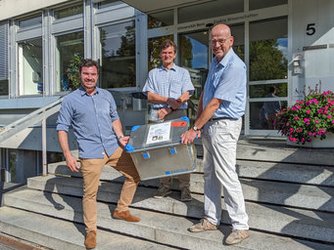
The sensor, which was developed and built at MPS, has arrived in Bern. There the next phase of preparations for ESA's Jupiter mission will begin.
The sensor JEI (Jovian Electron and Ion Sensor), which will from 2029 onwards study the distribution of high-energetic electrons and ions in the Jovian system on board ESA's JUICE (Jupiter Icy Moon Explorer) spacecraft, has been completed. JUICE is scheduled to be launched in 2022, but JEI's journey has already begun. Yesterday, the sensor, which has been developed, built, and tested at the Max Planck Institute for Solar System Research (MPS) in…